Apala Aitriyi
The female sage Apala is the seer of the seven mantras of Rigveda, Mandala 8, Sukta 91.
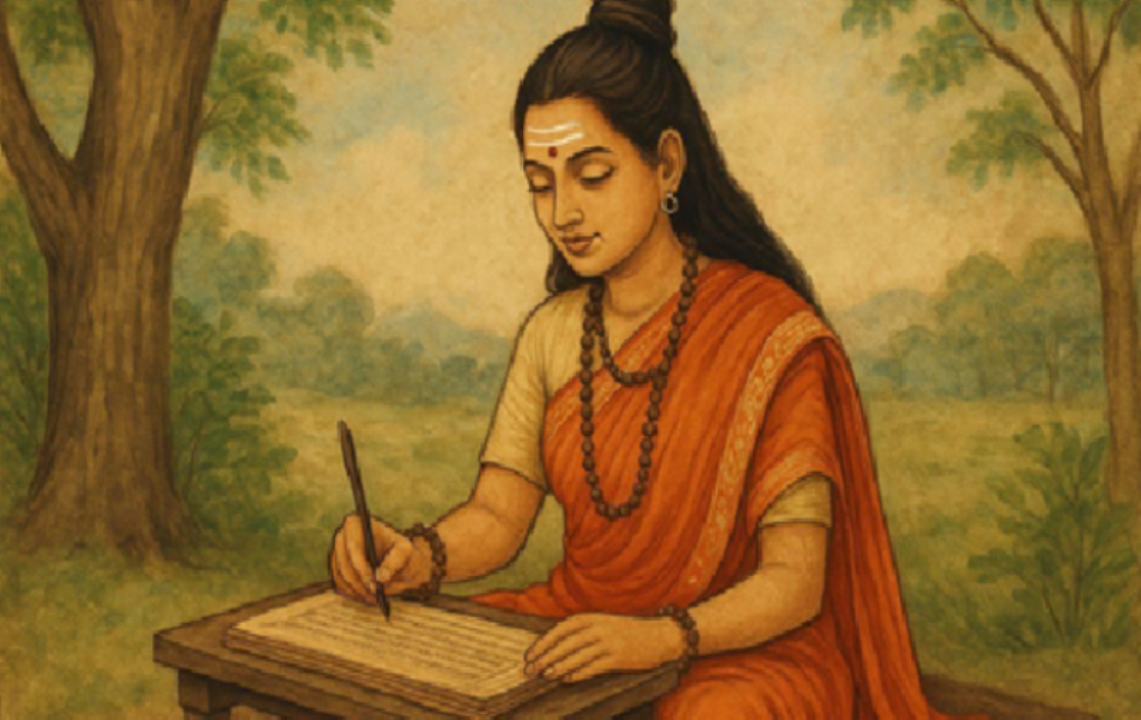
कन्या॑ वार॑वाय॒ती सोम॒मपि॑ स्रु॒तावि॑दत् । अस्तं॒ भर॑न्त्यब्रवी॒दिन्द्रा॑य सुनवै त्वा ।
श॒क्राय॑ सुनवै त्वा ॥
असौ य एषि वीरको गृहंगृहं विचाकशत् । इमं जम्भसुतं पिब धानावन्तं करम्भिणम् ।
अपूपवन्तमुक्थिनम् ॥
असौ च या न उर्वरादिमां तन्वं मम । अथो ततस्य यच्छिरः सर्वा ता रोमशा कृधि ॥
खे रथस्य खेऽनसः खे युगस्य शतक्रतो । अपालामिन्द्र त्रिष्पूत्व्यकृणोः सूर्यत्वचम् ॥
Rugved 8.91
The Tale of Apālā Ātreyī Ṛṣikā Apālā is the seer of seven mantras from Maṇḍala 8, Sūkta 91 of the Ṛgveda. In this Sūkta, Apālā offers Soma to Indra and prays for health, radiance, and well-being. One evening, a bullock cart arrived and came to a halt at the ashram of Ṛṣi Ātreya, situated on the banks of the Sarasvatī. A young woman stepped down, her clothes soiled with dust, her head bowed. Her name was Apālā — the daughter of the Ātreya lineage, who had been married off with great fanfare only a short while ago. The Ṛṣi ran outside. "Child! So suddenly? And all alone, with the cart driver?" Apālā gave no reply. She merely shifted her veil slightly, and the Ṛṣi's heart trembled. On his daughter's skin, blemishes had erupted everywhere; it was rough and cracked, resembling the bark of a tree. The young maiden of once-famous beauty in the countryside was now standing there, hiding her own face. "Father..." Apālā's voice broke. "He... said that there is no longer a place for me in his home. He says that this disease is the fruit of some sin of mine, and that it will bring sorrow and poverty to the household." The Ṛṣi's wife rushed over and embraced her daughter, but Apālā gently drew herself away. "Mother, do not touch me. I do not wish for this disease of mine to also..." "Mad girl!" The mother grabbed her tightly once more. "Skin diseases are not eaten like a snack so that they leap from one body to another. Your husband is a fool, child, and devoid of mercy." That night, Apālā sat alone in a corner of the ashram. Looking up at the stars, she thought to herself: What sin have I committed, O Lord Indra, that my very body has become my enemy? Every morning, I would praise you. Days passed. Apālā immersed herself in the chores of the ashram, but a deep desolation had settled in her heart. The women of the village would turn their faces away upon seeing her; children would run away from her. "Do not touch her," mothers would tell their children, "the wrath of the gods is upon her body." कन्या॑ वार॑वाय॒ती सोम॒मपि॑ स्रु॒तावि॑दत् । अस्तं॒ भर॑न्त्यब्रवी॒दिन्द्रा॑य सुनवै त्वा । श॒क्राय॑ सुनवै त्वा ॥ Ṛgveda 8.91.1 Gujarati Translation: A maiden was going to fetch water when she encountered the Somalatā on the way. She was taking it to her home and said: "I will press thee for Indra; I will press thee for the mighty Indra." One morning, as Apālā was going to the riverbank to fetch water, she encountered the Somalatā on the way. (The Ṛgvedic Soma is reconstructed as a leafless, green, succulent plant with jointed branches. Juice was extracted by pressing the branches. Some scholars associate it with the Ephedra species) — which the village elders called "Somalatā." Her father used to say that the juice of this plant is offered to Lord Indra in sacrifices, and to whosoever offers it with faith, Indra listens. Apālā's hands trembled. She did not have the sacred stones to extract Soma — those are found only in the sacrificial pavilion. But something blossomed in her mind, a stubborn faith that transcended logic. "If the stone is not to be found," she thought to herself, "then my own body shall become the stone." She broke a branch of Soma and began to chew it with her teeth. A bitter, pungent juice spread in her mouth, but she continued to chew until the juice began to drip into her palm. असौ य एषि वीरको गृहंगृहं विचाकशत् । इमं जम्भसुतं पिब धानावन्तं करम्भिणम् । अपूपवन्तमुक्थिनम् ॥ Ṛgveda 8.91.2 Gujarati Translation: O heroic and radiant Indra, you visit house to house. Drink this pressed Soma-juice crushed by my teeth — which is endowed with grain, karambha, pūpa, and praise. Raising her hands toward the sky, she said, "O Indra, I do not have the grandeur of a sacrifice, nor the mantras of the Ṛtvijas. I have only my faith. This juice that I have extracted with my own teeth — if you are truly just, then look upon me." आ चन त्वा चिकित्सामोऽधि चन त्वा नेमसि। शनैरिव शनकैरिवेन्द्रायेन्दो परि स्रव॥ Ṛgveda 8.91.3 Gujarati Translation: O Soma, we do not fully know thee nor fully understand thy movement. Therefore, O Soma-drop, flow gently and quietly for Indra. The wind suddenly stopped. Even the river water seemed to stand still for a moment. Apālā felt that a radiant shadow was descending from amidst the clouds in the sky — wielding a vajra, adorned in golden armor, with a flash of lightning in his eyes. "Who are you, that you summon me so fearlessly? There is no oblation without fire, and yet in your voice, there is a heat that reached me without any altar." Indra's voice was like thunder, yet it also held curiosity. Apālā was not frightened. "I am Apālā, the daughter of the Ātreya lineage. My husband has abandoned me because my skin is diseased. The village calls me inauspicious. My parents love me, but even in their eyes, I have seen pity — and pity, O Lord, is harder to bear than love. I wish to rise every day like the sun, but my own body has become a cloud for me." Indra looked at the Soma-juice resting in her palm. "Did you extract this with your own teeth? The juice that ought to be pressed by a stone, you pressed with your very body — your body itself became the sacrificial altar today." "Yes. I had nothing else." Indra remained silent for a few moments. Then he laughed — not like thunder, but a deep, sorrowful laugh. "Humans always offer me Soma in golden vessels, upon jewel-studded altars, and yet their faith is shallow — just as a shallow river makes a loud noise but does not quench thirst. You have given me nothing, girl, and yet the truth in your faith is like the flame of a fire — small, but true."
कुविच्छकत्कुवित्करत्कुविन्नो वस्यसस्करत् । कुवित्पतिद्विषो यतीरिन्द्रेण संगमामहै ॥ Gujarati Translation: Will Indra make us powerful? Will he do much good for us? Will he make us prosperous? We, who have turned away from our husbands, unite with Indra.
"So will you grant me a boon, O Lord?" Apala's voice trembled with hope and fear.
Lord Indra spoke in a deep and affectionate voice, "Apala, I am pleased by your devotion. Speak, which of your desires can I fulfill?" — Just as dawn breaks only when the night recedes, इमानि त्रीणि विष्टपा तानीन्द्र वि रोहय । शिरस्ततस्योर्वरामादिदं म उपोदरे ॥ Gujarati Translation: O Indra, cause these three regions to grow—my father's hairless head, his dried-up field, and this body of mine. Here, the three "regions to be grown" are indicated as the father's head, the father's field, and Apala's body. असौ च या न उर्वरादिमां तन्वं मम । अथो ततस्य यच्छिरः सर्वा ता रोमशा कृधि ॥ Gujarati Translation: This dried-up land, this body of mine, and the head of my father—make all these fertile and prosperous; cause growth and hair to sprout in all of them. "Lord," Apala said, bowing to Indra, "Three places that are desolate — my father's head, which has been hairless for years and village boys mock him; his field, which has been dried up for years without rain; and my own diseased body, which prevents me from blossoming fully. Can you make these three flourish, O Lord?" Indra smiled. "You ask more for your father than for yourself?" "Your faith still astounds me, Apala. For a woman who thinks of her father's field and his welfare before her own wounds are healed, granting these three boons is like paying a debt to ṛta (cosmic order) — for just as the sun does not rise solely for itself, my grace is not for one person alone. Go, and behold: hair will sprout on your father's head like new leaves budding in spring, and his field will bend low with crops just as paddy fields bend in autumn." Indra summoned his chariot — golden, pulled by two horses. He extended his hand toward Apala.
खे रथस्य खेऽनसः खे युगस्य शतक्रतो । अपालामिन्द्र त्रिष्पूत्व्यकृणोः सूर्यत्वचम् ॥ Gujarati Translation: O Śatakratu (Indra of a hundred sacrifices), passing me through the hole of the chariot, the hole of the cart, and the hole of the yoke three times, you purified me and made Apala radiant like the sun. "First, pass through the hole of the yoke," Indra said. "That hole is narrow, just as the womb's gateway is narrow. Whoever passes through it is reborn — just as the sun is reborn every day from the womb of the night, yet remains the same sun."
Apala went to the hole of the yoke with trembling hands. Her body barely fit; her skin stretched and itched, but clenching her teeth, she pulled herself through it. As soon as she emerged, a layer of her skin, old and diseased, remained behind — just as a snake sheds its slough. "Once more," Indra said, "now through the hole of the chariot. Even when fire burns wood twice does the ash become pure." This hole was even narrower. Tears came to Apala's eyes, but she thought of her father's face, who was afraid to even touch her upon seeing her. She pushed herself, and for the second time, the layer of skin shed. This time, the skin underneath shone lightly, like the early morning sky. "Lastly," Indra's voice had now grown gentle, "through the hole of the chariot wheel. This wheel is the very counterpart of the Sun, Apala — just as the Sun moves in the sky, this wheel moves on earth, and both are bound by the thread of ઋત (Cosmic Order). Whosoever passes through this embodies the brilliance of the Sun within themselves, and finds their place in that very cycle of ઋત (Cosmic Order). Apala gathered herself one last time. The wheel's hole was the narrowest, and the pain the most intense. But when she emerged, her skin was completely new — clean, glowing, as if the rays of the Sun had descended into her body. Seeing her reflection in the river water, Apala was stunned. For the first time in years, she looked at herself without self-loathing. Indra extended his hand in the direction of Atri's field. Clouds began to gather on the horizon, as if the sky itself had rushed forth to repay the debt of Apala's faith. As Apala walked towards the ashram, the first rain began to fall behind her — the first rain after years of drought. The sage could not recognize his daughter at first. "Who are you?" he asked, and then trembling, looked into her eyes. "Apala?! Daughter, this... how is this?" He passed his hand over his head, and stopped in astonishment — where there had been baldness for years, a thin line of soft, black hair had now grown. "This... this is my head! Daughter, what is this?" "Indra Deva bestowed grace upon me, Father, and upon you too," Apala said softly, a smile sparkling in her eyes. "I asked him for three boons — your head, your field, and my own body. He granted all three. But to tell you the truth, I feel grace comes only when we do not stop believing in ourselves — even if the whole world abandons us." Overcome with emotion, the sage choked up. "I used to laugh off my baldness for years, daughter. But you remembered even that, when your own pain was so great."
That night, when the entire hermitage was asleep, Apala went to the riverbank once again. Sitting beneath the stars, as she reflected upon her experience, before her vision — her pain, her fear, and a description of Indra's grace began to float. Words began to flow naturally from her lips, First she sang of that moment when she had found the twig of soma by the riverbank: *"कन्या वार्आवयती सोममपि स्रुताविदत्।* *अस्तं भरन्त्यब्रवीदिन्द्राय सुनवै त्वा शक्राय सुनवै त्वा॥"* "The maiden fetching water found the soma fallen in the flowing stream; taking it towards home she said: 'I shall press thee for Indra, I shall press thee for Śakra.'" Then she sang of the three boons that she had begged of Indra: *"इमानि त्रीणि विष्टपा तानीन्द्र वि रोहय।* *शिरस्ततस्य उर्वरामाददिं म उपोदरे॥"* "O Indra, cause these three places to grow — my father's head, his field, and this body of mine." And finally, when she began to sing of the occasion of passing through her three apertures, lines slipped from her lips automatically — as though Indra himself had seated upon her tongue: *"खे रथस्य खेऽनसः खे युगस्य शतक्रतो।* *अपालामिन्द्र त्रिष्पूत्व्यकृणोः सूर्यत्वचम्॥"* "O Śatakratu, in the aperture of the chariot, in the aperture of the cart, in the aperture of the yoke, O Indra, you purified Apala three times, and bestowed upon her a skin radiant like the sun." Singing these three verses, a lump formed in Apala's throat. The very twig of soma, the three boons, and the three apertures that had been witnesses to her pain and her faith, were now becoming immortal in her mantra. By the time dawn broke, she had a complete hymn ready — the ninety-first hymn of the eighth mandala of the Rigveda, whose seer was none other than Apala Ātreyī herself. In the morning, when she recited that hymn to her father, tears came to the sage's eyes — this time not of sorrow, but of pride. He said, "Child, what you have composed is not merely the tale of my daughter. This is the story of every such woman whom the world has abandoned, yet who has not abandoned her faith. These ṛcas (verses) by which Lord Indra was pleased will now become a part of the Rigveda and will be immortal." The fame of Apala's hymn, by which Lord Indra had been pleased and had cured Apala's affliction, had reached far-off regions. One day, on an autumn evening, an elderly parivrājaka (wandering ascetic) arrived at the hermitage of Sage Ātreya — one who had traveled through many countries, whose beard was white like snow and in whose eyes the knowledge of distant lands gleamed. The elderly parivrājaka had traveled from the regions beyond the western ocean up to the snow-clad forests of the north. Sitting around the fire at night, when he heard Apala's story, the parivrājaka smiled. He said, "Hearing this tale, I feel that Apala's ṛcas (verses) have spread to far-off lands; in other regions too, ordinary people follow this for the blessings of the gods — as though the gods understand in the same language everywhere." In the west where the sun sinks into the ocean, there is a country called Britain, in it is a place called Cornwall. There stands a large round stone, with a large aperture made in the middle — they call it the 'holed stone'. The people there believe that if a child suffers from a skin disease or weak bones, passing them through that aperture three times, and then dragging them on the grass, cures the ailment. Elders too, suffering from back pain, emerge nine times from that aperture in the direction opposite to the sun. The young rishis' eyes widened. "This is... just like what happened with Apala — casting off the old, false form and attaining the true form." Just like that, our assumption is that there has never been any contact between those people and us, yet they follow this; which means somewhere our assumption is wrong. The young rishis asked, "And besides those western regions?" "Beyond the mountains, where our own language's brothers and sisters dwell — they call themselves Parsis (modern-day Iran). Their priests too extract the juice of a plant similar to our soma, which they call 'homa'. They also pound that juice, mix milk, and offer it for healing and purification. They do not have the ritual of passing through an aperture, but their entire system of faith is just like ours — impurity is a disease, and through a pure offering the god removes it. It is said that both our peoples, Vedic and Parsi, have sprung from the same ancient lineage, like two branches of the same tree." Gazing towards the flame of the fire, the young rishis asked, is this observance found in any other region as well? The parivrājaka's tone grew somewhat grave. "In the north, where the snow never melts, the shamans there — their healer-priests — believe that disease itself is a call from the gods. In their tales, the future shaman has his body torn to pieces by the gods in a dream, then new flesh is laid upon new bones, new blood is poured — and only then does he attain the power to heal. Upon the roof of their house there is a round aperture, from which smoke emerges; they believe that that very aperture is the gateway connecting heaven and earth, through which the shaman's soul journeys." The young rishis fell thoughtful for a few moments, then spoke softly, "Then Apala's disease was not a punishment, O wise sage. Perhaps that very thing was my call — my path to reach Indra." The parivrājaka nodded. "Precisely, from east to west, from regions of snow to deserts, humans have spoken the same truth in different languages: that which breaks is forged anew. And he who dares to pass through the narrow gateway is reborn on the other side — whether that gateway be the wheel of a chariot, the holed stone of a mountain, or the smoke-hole of a yurt." That night everyone sitting around the fire fell silent, as though the voice of those unknown people of distant lands was their own. The truth is singular: the round aperture is like the womb's gateway, and to pass through it means to be reborn anew." When the rishi-assemblies were compiling the hymns of the Rigveda, a hymn was also included therein whose composer was no rishi, but a rishika — Apala Ātreyī, who had pressed soma with her teeth, and having passed through the three apertures had regained her life. The very people who used to turn their faces away upon seeing her now proudly narrated her story to everyone. But for Apala, the true victory did not lie in the transformation of her skin — it lay in that moment when she, despite being scorned and alone, stood upon the riverbank and raised her voice, and Lord Indra hearkened to her prayer. Because sometimes, healing does not come from the outside — it begins when we, despite being broken and shattered, harbor the courage to stand up for ourselves. Apala's skin may have been healed by Indra, but her courage, her faith — that was solely her own, which conferred upon Apala the status of a rishika (female seer).
Leave a reflection
Your name and words appear below. Your email is kept private and never shown.